%20--%3e%3csvg%20version='1.1'%20id='Layer_1'%20xmlns='http://www.w3.org/2000/svg'%20xmlns:xlink='http://www.w3.org/1999/xlink'%20x='0px'%20y='0px'%20viewBox='216.1%2082.4%20368.5%20368.5'%20style='enable-background:new%20216.1%2082.4%20368.5%20368.5;'%20xml:space='preserve'%3e%3cstyle%20type='text/css'%3e%20.st0{fill:%23FFFFFF;}%20.st1{opacity:0.2;}%20.st2{opacity:0.2;enable-background:new%20;}%20%3c/style%3e%3cg%3e%3cg%3e%3cg%3e%3cpath%20class='st0'%20d='M360.8,255.4c5.8,1.5,11.2,2,17,2c31.6,0,63.7-19,68.5-53c3.4-19-4.4-41.8-26.2-41.8%20c-21.4,0-34.5,19.9-37.9,38.9l-0.9,5.8h-68.6c6.8-57.4,59.8-102.6,117.2-102.6c58.4,0,94.8,43.7,85.6,102.1%20c-7.8,46.7-45.2,87.1-91.9,97.7l-10.7,45.7h-66.6L360.8,255.4z'/%3e%3c/g%3e%3cpolygon%20class='st0'%20points='332.4,434.3%20339.2,390%20408.7,390%20399,434.3%20'/%3e%3c/g%3e%3cg%3e%3cg%20class='st1'%3e%3cpath%20d='M352.2,247.8c5.8,1.5,11.2,2,17,2c31.6,0,63.7-19,68.5-53c3.4-19-4.4-41.8-26.2-41.8c-21.4,0-34.5,19.9-37.9,38.9%20l-0.9,5.8h-68.6C310.9,142.2,363.9,97,421.3,97c58.4,0,94.8,43.7,85.6,102.1c-7.8,46.7-45.2,87.1-91.9,97.7l-10.7,45.7h-66.6%20L352.2,247.8z'/%3e%3c/g%3e%3cpolygon%20class='st2'%20points='323.8,426.7%20330.6,382.4%20400.1,382.4%20390.4,426.7%20'/%3e%3c/g%3e%3c/g%3e%3c/svg%3e)


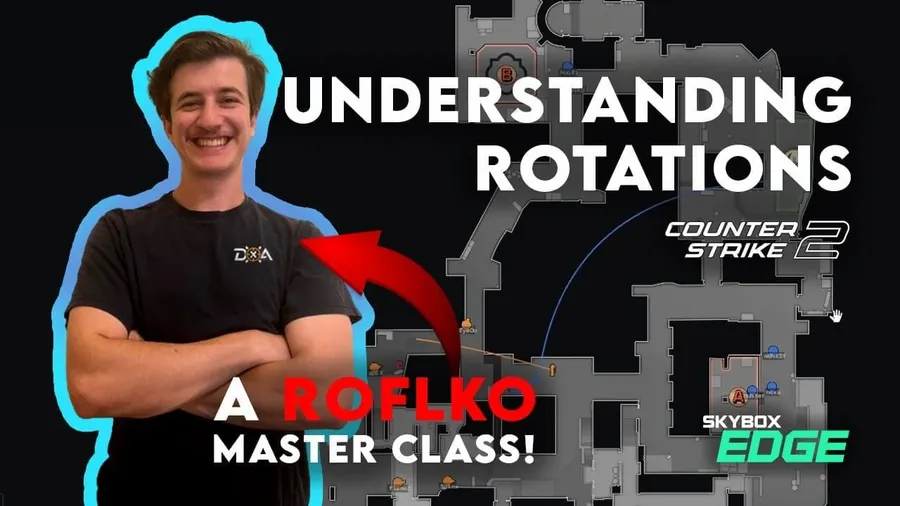

In the fast-paced world of Counter-Strike, understanding rotations can be the difference between winning and losing. Today, we’ll break down this critical aspect of gameplay, making it easy for you to level up your game.
Common Map Layouts
Knowing common map layouts is essential for predicting enemy movements and planning your strategies. For instance, on Inferno, the typical CT setup is two players at Banana and three at A, while T-side often has two at Banana, two at Second Mid, and one at T-Ramp. These configurations aren't set in stone but give you a solid foundation to start from. Remember, understanding these layouts can help you anticipate and manipulate rotations effectively.
Who is Playing Where?
Identifying who is playing where on the map can give you a huge advantage. Knowing that Nexa and Hunter usually hold A on Inferno, with Hunter in pit and Nexa on site, allows you to predict their movements. As we’ve observed, “Tracking key players' positions helps you understand rotations better.” This information is crucial in both PUGs and team games, as it lets you exploit weak points and make smarter plays.
“Tracking key players' positions helps you understand rotations better.”
Common Mistakes
There are several common mistakes players make when it comes to rotations. One major error is not understanding the information you've given to the enemy. For example, if your team makes a lot of noise taking A control, the CTs will know your plan and won't be easily fooled by a B fake. A common fix is to mix up your playstyle and go quiet after making noise.
“Avoid predictable patterns to keep your opponents guessing.”
Keep Your Fakes Consistent
Lastly, keeping your fakes consistent is crucial. If you've been taking Mid control with smokes and flashes every round, your fake should look the same. If it suddenly looks different, the enemy will know it’s a fake. “Consistency is key when selling fakes” ensuring that your opponents can’t easily distinguish between a real push and a fake. This tactic helps you pull rotations effectively and create opportunities to strike.
"Consistency is key when selling fakes"
By mastering these concepts, you'll enhance your game knowledge and performance. Remember, the key to improving in Counter-Strike is understanding rotations and using this knowledge to outsmart your opponents. Stay tuned for more tips and tricks to dominate the game!
Watch the full video over on our youtube channel: